Small Habits, Remarkable Changes: How Small Daily Actions Can Shape the Person You Become
12 min readsmall habits, remarkable changes
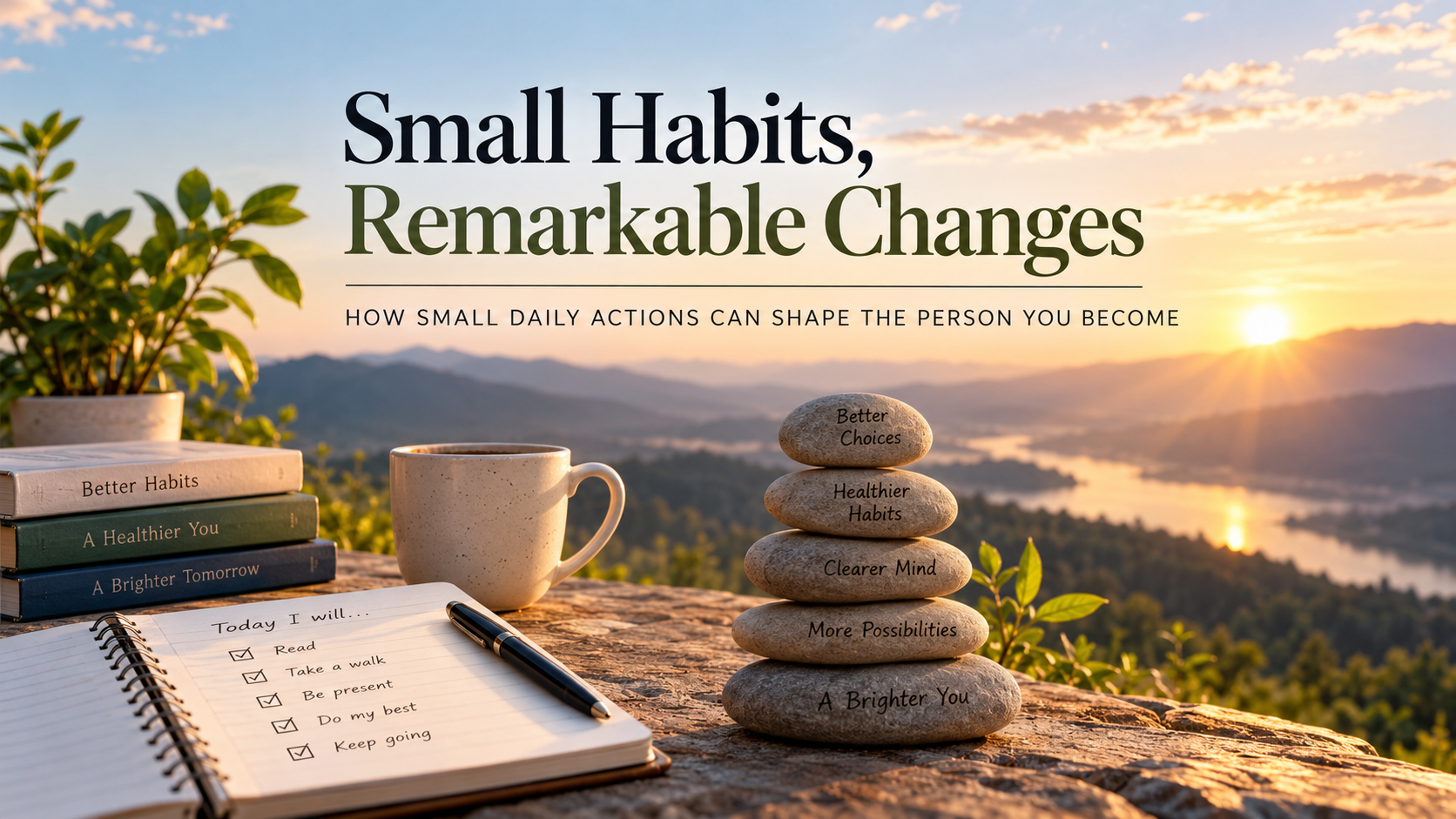
Small Habits, Remarkable Changes
### How Small Daily Actions Can Shape the Person You Become
By O’ ZAM | movingzero.com
Have you ever decided to change your life, only to find yourself returning to the same old routine a few days later?
Perhaps you planned to read more books, exercise every morning, spend less time on your phone, or finally begin a project you had been postponing. At first, the excitement was real. You felt ready to become a better version of yourself. But as the days passed, the excitement faded, daily responsibilities took over, and your plans slowly disappeared.
This experience is familiar to many of us. We often want remarkable results, but we try to achieve them through sudden, dramatic changes.
What if the secret to meaningful progress is not doing something extraordinary once, but doing something small consistently?
A few pages of reading. A short walk. Ten minutes of focused work. A moment of reflection before going to bed.
These actions may seem insignificant when viewed individually. Yet, when repeated over time, they can influence how we think, how we spend our time, and how we approach our goals.
Remarkable changes often begin with ordinary actions repeated with intention.
1. The Problem With Trying to Change Everything at Once
When we decide to improve our lives, we sometimes create an ambitious plan.
We promise ourselves that we will wake up early, exercise daily, read a book every week, learn a new skill, eat better, and become more productive. We imagine the person we want to become and try to transform our entire routine overnight.
The problem is not necessarily the ambition. It is the size of the change we expect ourselves to maintain.
A demanding routine requires time, energy, planning, and commitment. When work becomes stressful or family responsibilities increase, the routine may become difficult to follow. Missing one day can then lead to disappointment, and disappointment can become an excuse to stop altogether.
Consider two people who want to develop a reading habit.
The first decides to read for two hours every evening. The second begins with ten minutes before bed.
The first person may make faster progress on days when everything goes according to plan. The second has chosen a routine that is easier to fit into an ordinary day.
Neither approach guarantees success. However, the smaller commitment may be easier to repeat, especially when life becomes busy.
Instead of asking, “How much can I accomplish today?” try asking:
“What can I do today that I can realistically continue tomorrow?”
That question changes the starting point from ambition alone to sustainable action.
2. Small Actions Reduce the Difficulty of Starting
Often, the hardest part of a task is beginning it.
We may want to write a book but feel overwhelmed by the number of pages ahead. We may want to improve our fitness but struggle to find time for a complete workout. We may want to learn a new skill but postpone it because the learning process seems too demanding.
One way to overcome this resistance is to make the first step smaller.
Instead of writing an entire chapter, write one paragraph.
Instead of planning a perfect exercise routine, begin with a short walk.
Instead of studying for an hour, open your learning materials and focus for five minutes.
The purpose is not to convince yourself that five minutes will accomplish everything. It is to make beginning less difficult.
Once you start, you may decide to continue. If you do not, you have still practised showing up for the activity.
This is particularly useful when motivation is low. You do not need to feel completely ready before taking a small step.
Make the beginning easy enough that you have fewer reasons to avoid it.
Over time, repeating that beginning can help turn an intention into a more familiar part of your routine.
3. Your Daily Habits Reflect Your Priorities
We often describe ourselves through our intentions.
We say that we value knowledge, health, family, creativity, or personal growth. But our daily actions determine how much space those values receive in our lives.
Someone who says reading is important but never makes time for a book may genuinely value knowledge. The challenge is translating that value into a practical routine.
A person who wants to spend more meaningful time with family might begin by putting away the phone during dinner. Someone who wants to become a better writer might reserve fifteen minutes each morning for writing.
These actions are small, but they give an intention a place in the day.
You do not need to change your entire lifestyle to begin living closer to your values. You can start by identifying one important priority and giving it a little attention regularly.
Ask yourself:
- What do I say is important to me?
- Does my daily routine reflect that priority?
- What small action could bring the two closer together?
The answers may reveal that meaningful change requires less drama and more deliberate use of time.
4. Consistency Matters More Than Occasional Perfection
Imagine watering a plant only when you remember, sometimes giving it plenty of water and sometimes leaving it unattended for days. Compare that with giving it appropriate care as part of a regular routine.
Personal growth works differently from growing a plant in many ways, but the example illustrates an important idea: progress often depends on repeated attention rather than occasional bursts of effort.
You do not need to have a perfect day every day.
You need a way to return to what matters after an imperfect day.
Suppose you plan to walk for fifteen minutes every morning. One morning, heavy rain or an unexpected responsibility prevents you from doing so. That missed session does not erase the value of your previous efforts.
You can resume when circumstances allow.
Research on health-related habits suggests that habit formation varies considerably between individuals and behaviours. Repetition in a consistent context can help, but there is no universal deadline by which every habit becomes automatic. Source: Time to Form a Habit, a 2024 systematic review and meta-analysis.
This is a useful reminder not to judge your progress by an arbitrary number of days.
Some routines will become easier to maintain relatively quickly. Others will require adjustments and patience.
The goal is not perfection. It is continued participation.
5. Design Your Environment to Support Your Habits
Willpower is useful, but you can make daily actions easier by changing your surroundings.
Think about how your environment influences what you do.
If your phone is beside you while you work, checking notifications may become an easy distraction. If your book is placed on your bedside table, reading before sleep may be easier to remember.
If you want to exercise in the morning, preparing your clothes the night before removes one small obstacle. If you want to practise a new skill, keeping your materials ready can make starting less complicated.
These are simple changes, but they reduce the number of decisions required.
You can apply the same idea to habits you want to reduce. If you spend too much time scrolling through social media, consider turning off unnecessary notifications or keeping your phone outside your immediate workspace.
Rather than relying entirely on self-control, create surroundings that make your preferred behaviour more convenient.
A helpful question is:
“How can I make the action I want to take easier, and the distraction I want to avoid less convenient?”
Sometimes, improving your environment is more practical than repeatedly trying to overcome the same obstacle.
6. Measure Progress Beyond the Final Result
One reason people abandon new habits is that they expect immediate visible results.
Someone begins exercising and becomes frustrated when their fitness does not improve as quickly as expected. A new writer becomes discouraged because the first few pages seem ordinary. A person learning a language feels disappointed because conversations remain difficult.
But the early stages of progress are not always visible in the final result.
When you practise writing, you are also learning to organise thoughts and express ideas. When you exercise regularly, you are practising a routine that can support physical activity. When you read consistently, you are creating opportunities to encounter new ideas.
These benefits differ by activity and individual, and they do not guarantee a particular outcome. Nevertheless, the practice itself has value even before a major result appears.
Try measuring what you can control.
Did you spend time practising? Did you complete the small action you planned? Did you learn something from a difficult day? Did you return after missing a session?
You cannot always control how quickly a result arrives. You can often influence whether you continue taking meaningful steps towards it.
Progress becomes easier to recognise when you pay attention to the process as well as the outcome.
7. A Simple Way to Start Building Better Habits
You do not need a complicated productivity system to begin. Choose one habit and give it a clear place in your daily routine.
Here is a practical method.
Step 1: Choose one meaningful change.
Select something that genuinely matters to you. Avoid trying to improve every part of your life simultaneously.
Step 2: Make it small and specific.
Replace “I want to become more knowledgeable” with “I will read two pages after breakfast.”
Replace “I want to be more active” with “I will take a short walk after work.”
Step 3: Connect it to an existing routine.
For example, read after breakfast, stretch after getting out of bed, or write a few sentences before opening your email.
A familiar activity can serve as a reminder for the new one.
Step 4: Track your effort simply.
Use a calendar, notebook, or habit tracker to record whether you completed the action. Keep the process easy enough that tracking does not become another burden.
Step 5: Review and adjust.
If the habit repeatedly feels unrealistic, reduce its size or change its timing. A useful routine should fit your actual life, not an imaginary schedule in which you have unlimited time and energy.
Step 6: Resume after interruptions.
Missing a day is not a reason to abandon the whole plan. Look at what prevented you from continuing, make any necessary adjustment, and begin again.
You can use this approach for reading, writing, learning, exercise, mindfulness, or other everyday practices.
Start with one. Give it time. Let experience guide your next step.
8. Small Habits Can Change More Than Your Schedule
The value of a habit is not limited to the minutes it occupies.
A regular writing practice may help you become more comfortable expressing your thoughts. A habit of reviewing your spending may help you make more deliberate financial decisions. Setting aside time to listen to a family member without distractions may give your relationship more attention.
The effects will depend on the action, your circumstances, and how you practise it. Small habits do not solve every problem, and they cannot replace the larger decisions that life sometimes demands.
But they can provide a practical way to begin.
There is also something meaningful about keeping a small promise to yourself. When you repeatedly follow through on an achievable commitment, you create experiences of acting according to your intentions.
You begin to see that change does not always require a dramatic announcement or a completely new identity. Sometimes, it begins with a quiet decision made in the middle of an ordinary day.
A few pages become a reading routine. A few sentences become a manuscript. A short walk becomes a regular opportunity to move. A few minutes of reflection become a way to approach tomorrow with greater intention.
The individual actions remain small. Their place in your life can gradually become more significant.
Conclusion: Begin Small, but Begin With Purpose
We often admire people for their achievements without seeing the ordinary actions that contributed to them. We notice the finished book, the developed skill, the completed project, or the healthy routine. We do not always notice the small decisions repeated along the way.
You do not need to transform your entire life today.
Choose one thing that matters. Make the first step manageable. Give it a place in your routine, and return to it regularly. When your approach does not work, learn from the experience and adjust.
Do not underestimate a small action simply because its immediate result seems modest.
The purpose is not to make every minute productive or turn life into an endless improvement project. It is to use some of your time intentionally, in ways that reflect the person you want to become.
You may not notice a remarkable difference after one day. You may not see it after a week. But the actions you choose to repeat can gradually influence the direction in which you move.
You do not have to change everything to change something. You only have to begin with the next meaningful step.
And sometimes, that is where remarkable change begins.
About the Author
O’ ZAM is a writer and author interested in personal growth, mindful living, human behaviour, and the practical ideas that help people approach life with greater intention. Through books and articles, O’ ZAM explores how small decisions, thoughtful reflection, and consistent action can contribute to a more meaningful life.
Discover more ideas and reflections at [movingzero.com](https://movingzero.com/).
SEO Meta Description: Discover how small daily habits can lead to meaningful personal growth. Learn practical ways to build consistency, overcome procrastination, and create lasting change.
Suggested URL Slug: `small-habits-remarkable-changes`
Primary Keyword: small habits, remarkable changes
Related Keywords: daily habits for personal growth, how to build good habits, consistency and success, small steps to success, personal development tips, habit formation.